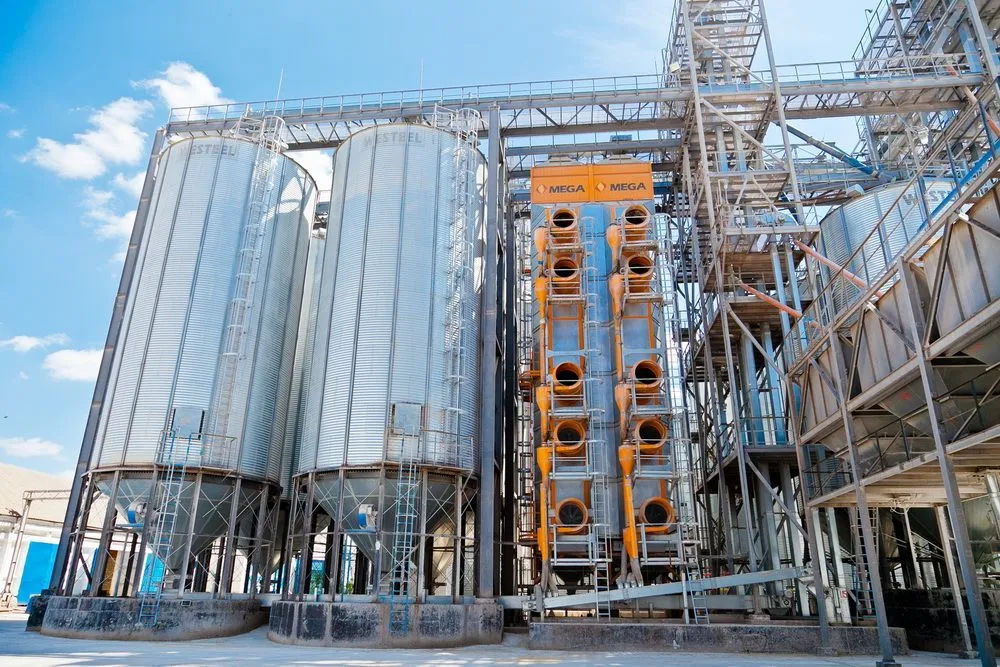
A recent case from our practice: the owner of a grain elevator near a river port commissioned a valuation of his complex — and the resulting figure surprised him greatly. The market value came out at one third of the price he had paid for the asset several years earlier. Did he make a mistake back then? No. Has he lost that money? Also no. Ukraine's elevator market has simply changed more than almost any other segment over these years, and today his asset is worth exactly that. Tomorrow, quite possibly, it will be worth something else.
Let us unpack what makes up the price of a grain elevator and what exactly happened to the market.
What you pay for when buying an elevator
The base unit of measurement in this market is the dollar per tonne of one-time storage capacity. But identical capacity can hide entirely different assets: a Soviet-era floor-storage warehouse and a modern automated silo complex are different generations of technology and different money.
It is important to understand where an elevator earns. The core income of a classic inland elevator is storage, along with grain intake, drying and cleaning. Intake speed at harvest peak is an important service factor, but the cash flow is formed above all by storage fees. Transshipment is where port terminals earn — a different economics and valuation logic altogether.
Then come the details an experienced buyer checks first. The drying facilities and their fuel: corn drying is one of the largest cost items, and the energy efficiency of the dryer feeds directly into the asset's price. An in-house certified laboratory: it allows the operator to form commodity lots with confirmed quality — a value factor in its own right. And logistics: a rail spur, truck intake speed, distance to working ports.
Prices the market has rewritten
Before the full-scale invasion, floor-storage complexes traded at around 90 US dollars per tonne of storage, modern silo complexes at 150–180. The picture today is different. Floor-storage elevators go for as little as 50 dollars per tonne. Silo complexes even in rear regions — Rivne and Ternopil oblasts — sell for up to 70 dollars, while large silo complexes in frontline-adjacent Mykolaiv oblast fetch below 60. The visible exception is small elevators of 7–15 thousand tonnes: in Kyiv oblast such assets still trade at around 150 dollars per tonne — demand for them is steadier, and the deal size is within reach of a far wider circle of buyers.
There are two reasons, both structural. The first is the geography of freight flows: exports have concentrated in the Black Sea ports, and assets whose economics were built on river logistics have lost a significant share of their load. The second is the spread of sleeve-type (silo-bag) storage: its cost per tonne is substantially lower, and small farms increasingly store grain on their own land rather than sending it to a classic elevator. Demand for inland elevator services has been squeezed from both sides — and that has fed straight into the value of the complexes themselves.
Our practice covers elevators across Sumy, Poltava, Zhytomyr, Kyiv and Mykolaiv oblasts. The price per tonne between assets that look identical on paper can differ by a factor of two — which is why the fair figure for a specific asset comes not from a "market average" but from a grain elevator valuation with a site inspection and a review of that asset's actual economics.
Value is the state of the market at the valuation date
Back to the elevator owner. There is no mistake in his story: several years ago he bought the asset in a market with working river logistics and paid a price that was fair for its time. What changed was not his decisions but the economic and political situation and the direction of freight flows. A valuation fixes value at a specific date under the current state of the market: today it is a third of the purchase price — a statement of fact, not a verdict.
The situation has a flip side: market trends move in both directions. If, after the war, logistics normalises and river routes regain their cargo, the value of that same elevator may move upward within a year or two. For an owner — Ukrainian or international — this is an argument for managing the asset with open eyes: knowing what it is worth today and revaluing it as the market moves.
Why a valuation when you are not selling
Most often an elevator reaches a valuer not for a sale but on banking business: the complex is pledged, or credit terms are being revised, and a revaluation is required. What sits inside is valued as a separate line: grain in storage is the classic working-capital collateral of agricultural companies. And when a farming business is pledged as a whole, the storage capacity is packaged together with machinery and agricultural land: the lender wants to see the value of the entire production chain, not a single link.
Ukraine's elevator market has contracted, but it has not stopped: assets are being bought, pledged and contributed to charter capital — at the new prices. In every such story, the winner is the party that knows the real value of the asset today — and understands what could change it tomorrow.



Contact
Let's discuss your task
Oleksii Kiselyov · CEO of Kanzas LLC
Write to us by email or messenger — I'll explain how and how soon we can complete the valuation. The initial consultation is free.