
Securities valuation
What we value

Share valuation
A share is a stake in a joint-stock company, and its value derives from the value of the issuer's business.
Read more
Bond valuation
A bond is a debt security under which the issuer undertakes to repay the principal at maturity and, for interest-bearing bonds, to pay periodic…
Read more
Promissory note valuation
A promissory note is a debt security embodying an unconditional obligation of the issuer to pay a fixed sum on a fixed date.
Read more
Investment Fund and Fund Unit Valuation
Ukrainian collective investment institutions issue investment certificates — securities evidencing an investor's share in a unit (mutual) fund's…
Read moreA security certifies the property rights of its holder — and it is these rights, not the certificate or the account entry, that determine its value. A share is worth what the underlying stake in the issuer's business is worth; a bond is worth what the market will pay for its future payments; a promissory note depends on the solvency of the parties liable under it. Independent securities valuation establishes the market or fair value of a specific instrument or an entire portfolio for a specific purpose — from a transaction or collateral to IFRS-compliant revaluation of financial investments.
Securities and financial instruments we value
- shares — from minority stakes to 100% shareholdings;
- bonds — government, corporate, municipal and project bonds;
- promissory notes — including overdue and distressed paper;
- investment certificates of Ukrainian asset management companies and collective investment funds;
- securities portfolios — equity and debt instruments of multiple issuers in any combination.
Each instrument type has its own page with detailed methodology — see the links above. This page covers the general framework and the valuation of mixed portfolios.
What determines the value of securities
- Instrument type. Equity securities are valued through the underlying business of the issuer; debt instruments — through the quality and schedule of future payments.
- Issuer's financial condition. For unlisted securities, the analysis of the issuer's financial statements is the core of the calculation.
- Liquidity. Active trading and real transactions in the instrument directly affect its market value.
- Stake size — for shares. Control premiums and minority or illiquidity discounts materially change the per-share value within a block.
When securities valuation is required
- purchase or sale of securities outside organised markets;
- pledge of securities as loan collateral;
- revaluation of financial investments and portfolios under IFRS;
- contribution to charter capital, including cross-border corporate structures;
- litigation and property disputes;
- mandatory buyout of minority shareholders (squeeze-out);
- transactions requiring valuation under the rules of the National Securities and Stock Market Commission of Ukraine;
- liquidation of the portfolio holder.
Valuation approaches for securities
For debt instruments the income approach is primary — above all the discounted cash flow method, which brings future payments to present value at a rate reflecting the issuer's credit risk. Shares are valued through the issuer's business, applying the income, asset-based (net asset value) and market approaches. The market approach also works directly with actively traded instruments: exchange quotations and actual transactions serve as a direct market benchmark.
For book-entry securities, the object of valuation is identified through securities account statements; documentary instruments such as promissory notes are inspected in the original, since a defect of form deprives the document of its legal force as a note.
Portfolio valuation
A portfolio is not valued as a simple sum of its components: each instrument is analysed individually — by type, issuer, quality and liquidity — and the results are consolidated into a single report. Portfolio engagements form a substantial part of our track record: in 2015–2020 the Kanzas company was one of the largest providers of asset revaluation for insolvent banks commissioned by the Deposit Guarantee Fund of Ukraine, including securities portfolios of varying quality. In total, we have valued share blocks of more than 100 companies across industries — from energy and construction to trade and healthcare.
Documents required for securities valuation
- securities account statement (for book-entry instruments) or the original documentary securities;
- issuer information: constituent documents and financial statements for 2–3 years;
- for debt instruments — issue terms: maturities, rates, payment schedule;
- client identification documents.
The exact list depends on the instrument type and the purpose of valuation and is agreed with the appraiser at the start of the engagement.
Questions and answers
Can unlisted securities be valued? Yes — this is the most common case in Ukrainian practice. In the absence of quotations, value is derived from the analysis of the issuer's business and financial statements.
What is IFRS revaluation of securities? The periodic measurement of the fair value of financial investments for financial reporting purposes. For portfolios it is performed regularly — typically annually at the balance sheet date.
How does share valuation differ from corporate rights valuation? Shares are securities issued by joint-stock companies; a participatory interest in an LLC constitutes corporate rights without issuing securities. The objects differ, but the methodology is closely related: in both cases the basis is the value of the underlying business.
Our team, including appraisers holding international valuation certificates, has worked with securities for over 20 years — from single promissory notes in inheritance cases to bank portfolios of hundreds of positions. Every engagement receives an individual approach: we are attentive to the client's situation, meet agreed deadlines and support the report until the purpose of the valuation is achieved. Contact us by email or messenger to discuss your task and receive a quotation.
What you may need a valuation for
We carry out expert valuation:
Share valuation
Bond valuation
Promissory note valuation

Fuel and CNG station chain valuation

Oil Depot and Fuel Terminal Valuation

Grain elevator valuation

Pharmacy Chain Valuation in Ukraine

Poultry farm valuation

Pipe plant valuation

Resort and Sanatorium Valuation

Warehouse Valuation in Ukraine

Retail property valuation

Office Building Valuation
Valuation-subject certificates
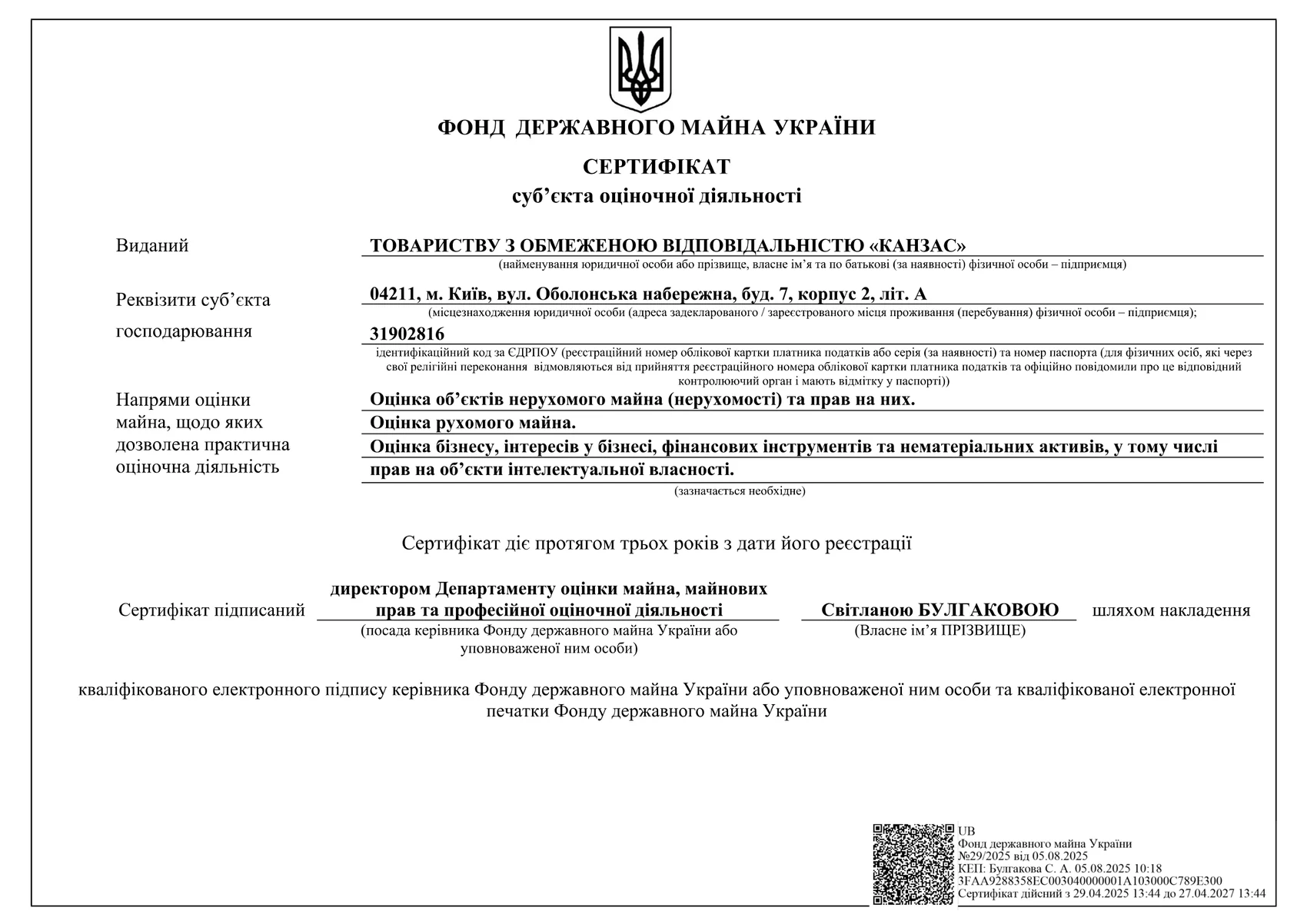
Kanzas LLC
Valuation-activity subject certificate No. 29/2025, issued by the State Property Fund of Ukraine on 5 August 2025.
Open certificate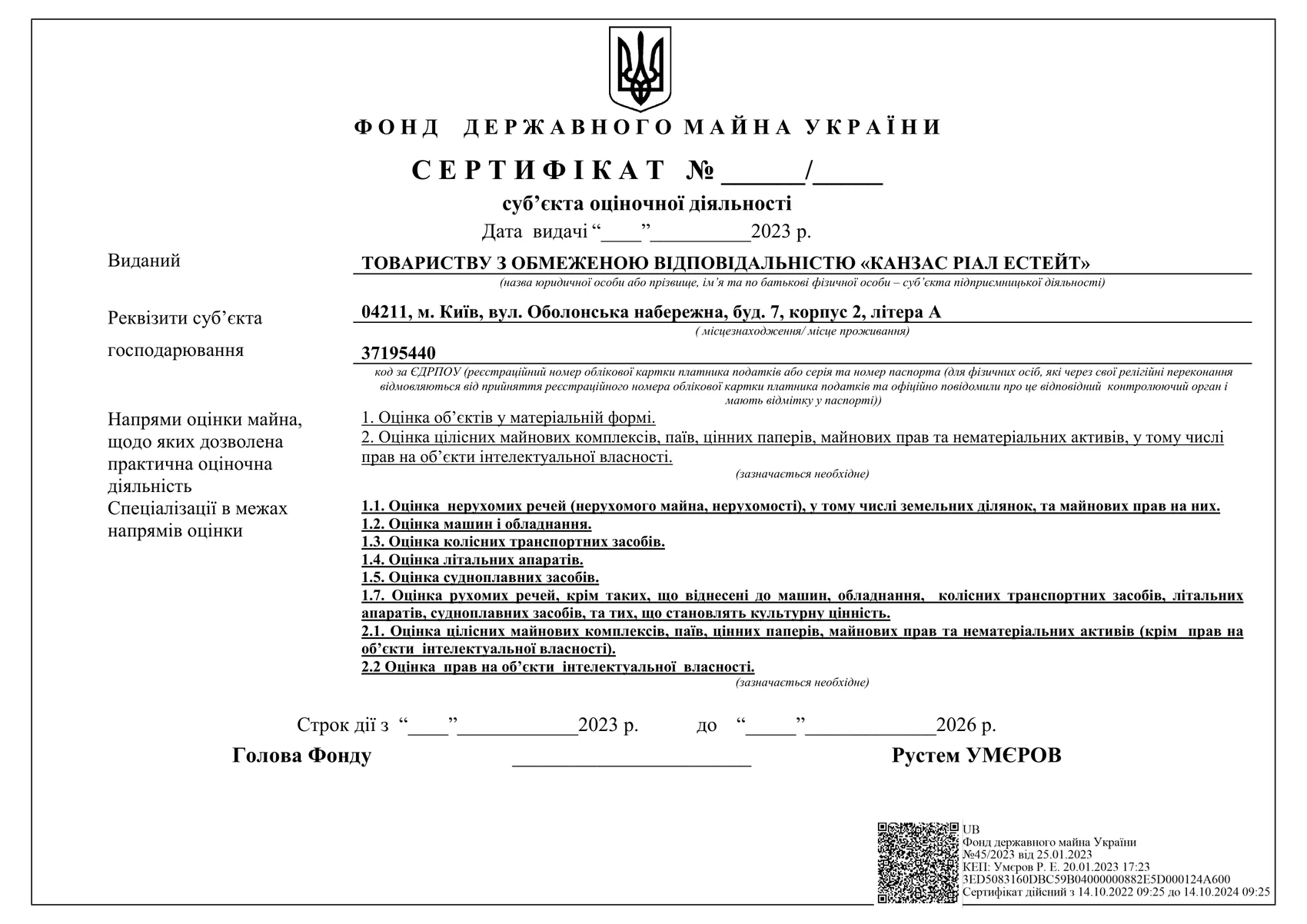
Kanzas Real Estate LLC
Valuation-activity subject certificate No. 45/2023, issued by the State Property Fund of Ukraine on 25 January 2023.
Open certificate

Let's discuss your task
Oleksii Kiselyov · CEO of Kanzas LLC
Write to us by email or messenger — I'll explain how and how soon we can complete the valuation. The initial consultation is free.