
Valuation of property rights and claims
What we value

Market Rent Valuation
Kanzas provides independent Market Rent valuations for privately owned premises and other assets in Ukraine.
Read more
Valuation of accounts receivable
Accounts receivable are property rights recorded on a company's balance sheet: this is what the asset is called in accounting terms, while legally it…
Read more
Valuation of loan claims and portfolios
A claim under a loan agreement is an asset: the creditor is entitled to the principal, interest and penalties, and this claim can be sold, assigned…
Read more
Off-Plan Property Valuation
Until a building is commissioned and title is registered, the buyer of an apartment in a Ukrainian new build owns not real estate, but property…
Read more
Mineral Rights & Subsoil Use Valuation
In Ukraine, the subsoil belongs to the Ukrainian people: a quarry or deposit cannot be bought like a land plot.
Read moreProperty rights are a distinct object of valuation: what is valued is not a thing, but a right connected with it. An apartment in a building under construction does not physically exist yet — but the property rights to it are already sold, pledged and inherited. A loan is not the bank's property in the ordinary sense, yet the claim under it has a perfectly definable market value. Independent valuation of property rights establishes the monetary equivalent of such rights at a specific date — for a transaction, collateral, litigation or financial reporting.
Which rights qualify: legal framework and classification
Under Article 3 of the Law of Ukraine "On Valuation of Property, Property Rights and Professional Valuation Activity", property rights subject to valuation include any rights connected with property other than ownership itself: possession, use and disposal as components of ownership, the special property right to an object of unfinished construction and to future real estate, claims (rights of demand), and other specific rights — to conduct activities, to use natural resources, and so on.
In practice, property rights fall into rights in rem (tied to specific assets), contractual claims (under loans and commercial agreements), corporate rights and intellectual property rights. The latter two have dedicated sections on this site — corporate rights valuation and intellectual property valuation; this page and its subsections cover rights in rem and contractual claims.
Property rights and claims we value
- claims under loan agreements — single loans and debt portfolios, performing and distressed;
- receivables — claims under supply and service agreements;
- property rights to future real estate — apartments and commercial premises in buildings not yet commissioned;
- subsoil use rights — the extraction permit as the core asset of mining companies;
- land lease rights and easements;
- other specific rights, depending on the nature of your asset.
Loan claims and debt portfolio valuation — our core practice
The largest body of our property rights work is the valuation of loan claims: from single loans to portfolios of thousands of positions, both unsecured (consumer) and secured by land, real estate, vehicles or equipment. The bulk of this work was performed in 2015–2020 for the Deposit Guarantee Fund of Ukraine as part of the revaluation of assets of insolvent banks.
A separate class of engagements involves loans secured by the assets of large industrial companies. A bank cannot take "the business" itself as collateral, so security is structured over the assets of the entire production cycle: real estate, equipment, production lines, vehicles. Valuing the claim under such a loan effectively means a full revaluation of the enterprise's assets — and our track record includes many such engagements.
We also handle individual mandates: a borrower seeking to buy out the claim under their own loan from a bank or litigating against it; an investor interested in a collateralised asset who commissions a claim valuation before the purchase. It is not uncommon for the bank itself to recommend our company as the appraiser.
When valuation of property rights is required
- assignment or sale of claims and debt portfolios;
- pledge of property rights, mortgage transactions;
- purchase or sale of rights to future real estate;
- financial reporting, recognition and revaluation, including under IFRS;
- contribution of property rights to charter capital;
- litigation, quantification of damages or compensation;
- corporate reorganisation or liquidation;
- auctions and privatisation;
- insurance and other cases established by law or contract.
How the valuation proceeds: stages and approaches
The engagement starts with a free preliminary consultation: the appraiser reviews the object and the purpose of valuation, defines the basis of value and the document list, and proposes timing and fees. Then follow the engagement contract, information gathering, identification of the right and its associated risks and encumbrances, calculations, reconciliation of results and delivery of the valuation report.
The choice of approaches depends on the nature of the right. For claims, the income approach is primary: expected recoveries are adjusted for collection probability, collateral quality and timing, and discounted to present value. For rights to future real estate, the market approach applies — offers in the same or comparable developments, adjusted for the stage of completion. For use rights, income and market approaches are applied depending on available market data.
Documents required
The list depends on the classification of the right: a loan claim requires one set of documents, rights to a property under construction — another. The common core:
- title documents for the right (agreement, certificate, statement);
- documents for the underlying asset;
- for claims — loan or contract documentation, collateral details and servicing history;
- constituent documents and financial statements (for legal entities);
- client identification documents.
The exact list is agreed with the appraiser at the preliminary consultation.
Questions and answers
Can property rights be valued internally? An indicative figure for internal purposes can be produced in-house. But transactions, collateral, court proceedings and financial reporting require a report issued by a certified valuation entity — only such a report has legal force in Ukraine.
The valuation report is outdated — is a new valuation needed? The report is updated to a new date, which is faster than the initial engagement: the appraiser already knows the object, its specifics and the market. Report updates are a regular service for our recurring clients.
What exactly is valued when buying an apartment in a building under construction? Until the building is commissioned, the object of the transaction is the property rights to future real estate — and these rights are what is valued, based on the developer agreement, the stage of completion and market comparables.
Our team, including appraisers holding international valuation certificates, has valued property rights for over 20 years — from a claim under a single loan to bank portfolios and rights over the assets of major enterprises. Every engagement receives an individual approach: we are attentive to the client's task, meet agreed deadlines and support the report until its purpose is achieved. Contact us by email or messenger to discuss your case and receive a quotation.
What you may need a valuation for
We carry out expert valuation:
Valuation of accounts receivable
Valuation of loan claims and portfolios

Patent and Invention Valuation

Trademark and Brand Valuation

Know-How and Trade Secret Valuation

Fuel and CNG station chain valuation

Oil Depot and Fuel Terminal Valuation

Grain elevator valuation

Pharmacy Chain Valuation in Ukraine

Poultry farm valuation

Pipe plant valuation

Resort and Sanatorium Valuation

Warehouse Valuation in Ukraine

Retail property valuation

Office Building Valuation
Valuation-subject certificates
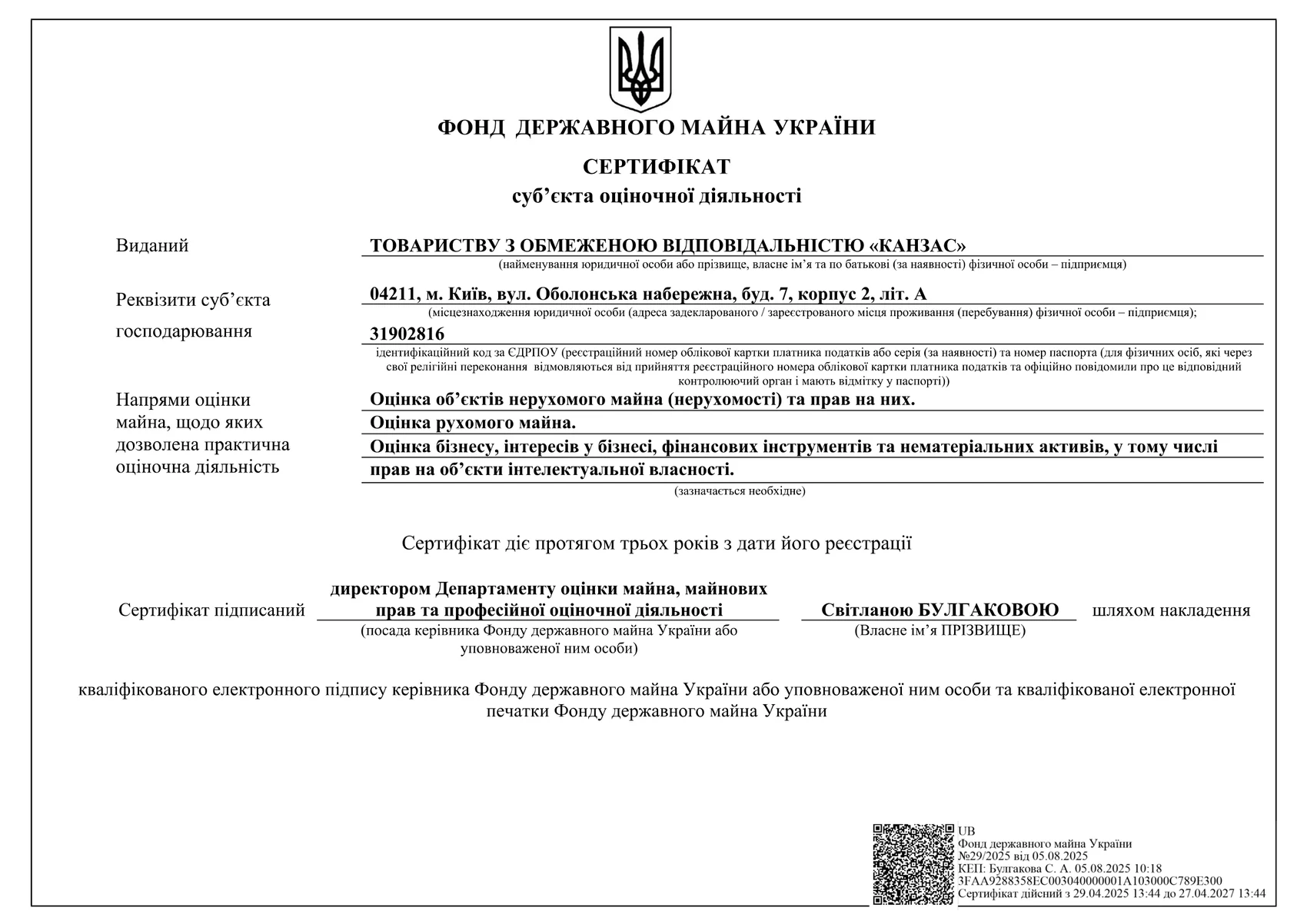
Kanzas LLC
Valuation-activity subject certificate No. 29/2025, issued by the State Property Fund of Ukraine on 5 August 2025.
Open certificate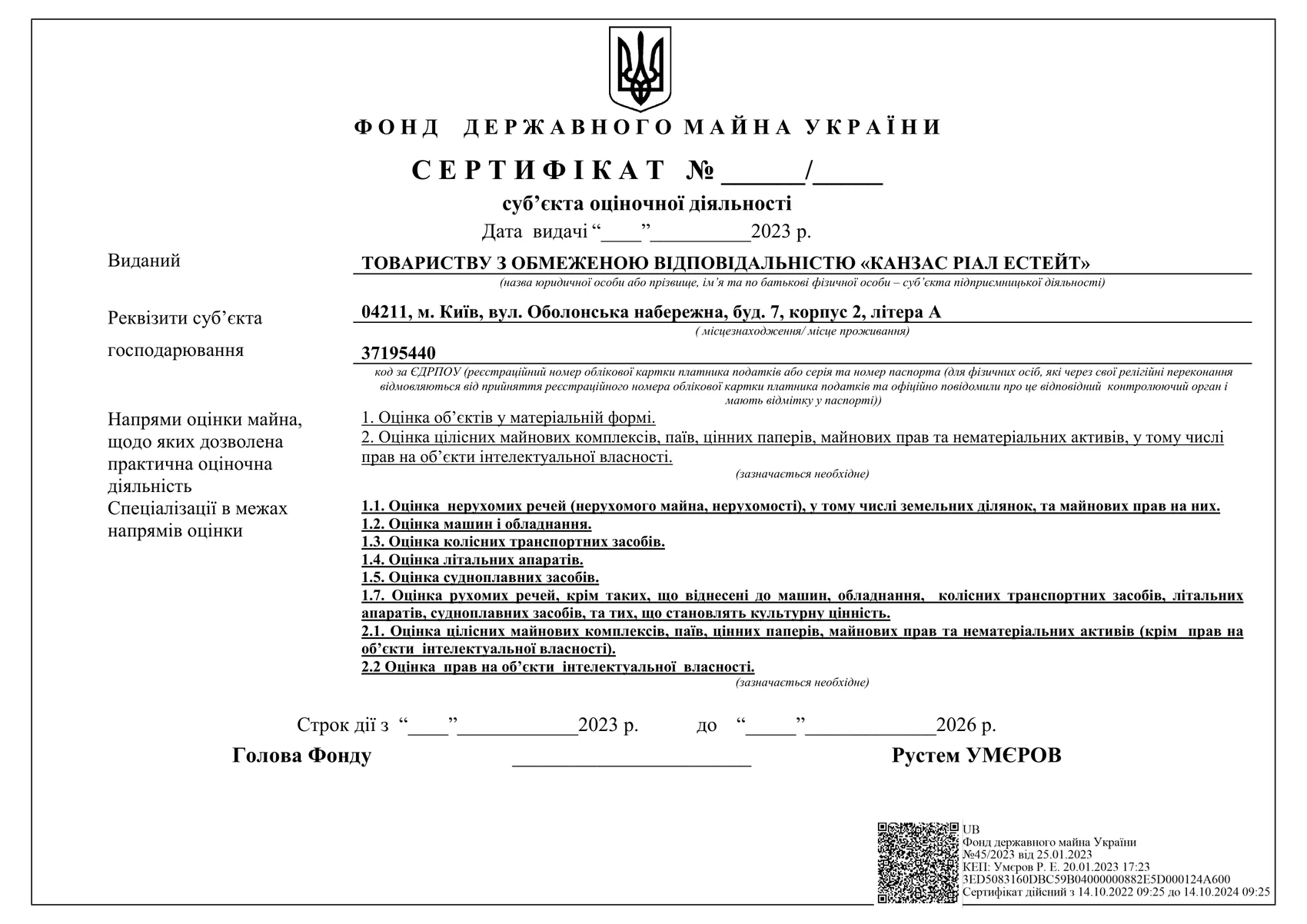
Kanzas Real Estate LLC
Valuation-activity subject certificate No. 45/2023, issued by the State Property Fund of Ukraine on 25 January 2023.
Open certificate

Let's discuss your task
Oleksii Kiselyov · CEO of Kanzas LLC
Write to us by email or messenger — I'll explain how and how soon we can complete the valuation. The initial consultation is free.